




All ProductsAges 12–18 • Flexible depth routes

Teen Activity Workbook Ages 12–18 | Think, Create & Explain

Question claims • Explain methods • Create practical outputs • Revise with a reason • Plan a manageable session

Help a teenager move beyond getting an answer to explaining why it makes sense. Explore reading, writing, maths and practical projects through worked examples, explained practice and flexible routes for deeper thinking.
Rs. 299.00 Regular price Rs. 999.00 70% OFF
  • Instant Digital Download
  • Secure Payment
  • Lifetime Access
  • Any Device / Easy Access

Secure Checkout

Razorpay Visa Mastercard RuPay UPI Google Pay PhonePe

Your payment information is protected and encrypted.

Teen Activity Workbook Ages 12–18 | Think, Create & Explain

About This Guide

Give Curiosity a Method to Work With

A confident answer can hide a missing reason. This teen learning workbook invites the learner to slow down, examine the evidence and show how an idea works. Reading, writing, mathematical reasoning and practical projects share a clear purpose: make an explanation another person can follow. Begin with an interesting question, try a small piece of work and keep one useful correction. The aim is reasoning the learner can describe, rather than a race through pages.

Question What a Claim Actually Establishes

The reading activities distinguish a claim from its evidence, a stated fact from an inference and an association from a complete causal explanation. Fictional cases give learners something concrete to examine without gathering private information. Writing lessons then ask them to preserve meaning, develop a useful paragraph and address an objection. A response becomes more precise when its scope and uncertainty are visible, instead of being hidden by impressive-sounding words.

Make Mathematical Thinking Visible

Worked models introduce ratios, fractions, percentages, data, shape and algebra before the learner attempts core and extension problems. Explanations retain units, denominators and assumptions, so a correct-looking number is only part of the task. Use substitution, a second method or a reasonableness check to inspect a result. Project prompts invite learners to apply a relationship and describe when their model would stop being appropriate.

Create Something With a Clear Purpose

Research and design activities connect a question with an output, constraints, evidence and revision. A labelled explanation, paper prototype, evidence map or selected portfolio piece gives the learner a reason to communicate clearly. The book distinguishes a planned test from an investigation actually performed. Supplied fictional information can support the reasoning when a real test is unsuitable, provided the learner labels it honestly and follows the setup guidance.

Choose Depth Without Comparing Learners

Foundation, extension and application routes make it possible to revisit a model, compare methods or develop a more independent output. The suggested age bands organise choices; they do not assess ability or require the same pace. Speak an explanation, use a notebook, type or make a labelled drawing when that better supports the task. Keep the intellectual question clear while adapting the way the learner responds.

Keep the Work, the Check and the Revision Together

The learning planner helps organise a small week and project actions, while the practice extract makes selected existing pages convenient to print. Optional adult-operated AI prompts include human checks and do not require a teenager’s AI account. Use the bundle alongside the learner’s other materials, with a responsible adult checking suitability. Build a collection of explanations, calculations and revisions that shows the thinking behind the finished work.

What You Will Receive

Your download includes the main teen learning PDF, a Practice and Projects extract repeating selected main pages, an adult AI prompt PDF and copy-ready TXT, an Excel learning planner, cover PNG, QR, customer start note and HTML resource page linking to the existing Google Sheets companion. The same prompts recur across formats. PDFs are not fillable; no physical book, qualification, complete curriculum or automated assessment is supplied.

  • Instant Digital Access

  • Easy-to-Follow Learning

  • Designed for Hands-On Learning

  • Builds Curiosity & Problem-Solving Skills

Why Choose This Teen Learning Playbook?

  • Turn an interesting question into an explanation with evidence.
  • Inspect units, assumptions and methods behind a mathematical answer.
  • Choose a manageable depth without ranking learners.
  • Create a practical output and explain one improvement.
  • Keep selected work with the reasoning that produced it.
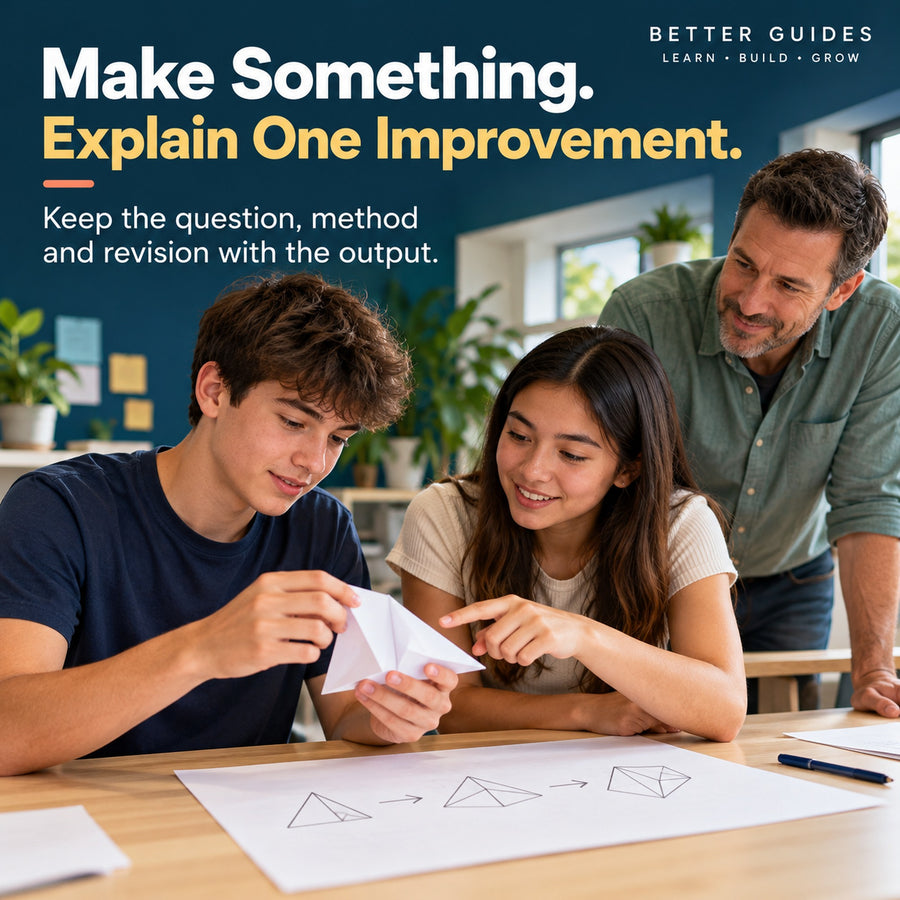
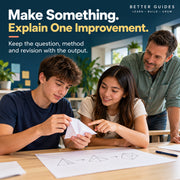
Fictional teens discussing a simple paper prototype and a labelled sketch.

What You Can Put Into Practice

  • Distinguish a claim, supporting evidence and an unresolved inference.
  • Explain a calculation with units and a checking method.
  • Draft a research question and source trail.
  • Develop a small project with constraints and revision.
  • Select a portfolio piece and describe the learner’s contribution.

What’s Inside

Critical Reading and Clear Communication

Examine claims, evidence, inference, sampling and uncertainty through original fictional cases. Writing activities cover purpose, paragraphs, summaries, paraphrasing, objections and presentations. Try the questions before checking the explanations, then revise a sentence or argument with a reason. Open responses are examples to compare with your thinking, not a demand to copy one exact wording or suppress a defensible alternative.

Numbers, Data, Shape and Algebra

Work through ratios, fractions, changing percentage bases, decimals, unit rates and time. Explore means, probability, conditional proportions and graph rates before moving to geometry, scale and algebraic relationships. Core and extension questions include explanatory answer pages. Application prompts ask for labelled quantities, a stated assumption and a limitation. These are selected learning topics, without a complete school-board syllabus or exam-preparation claim.

Research and Practical Design Projects

Narrow a broad interest into a question, plan a comparison, keep measurements honest and record a source trail. Design activities use a brief, constraints, prototype and specific revision. Portfolio work selects an explanation, mathematical solution and project with process evidence. Read the individual setup first; a drawing or analysis of supplied fictional results can replace an unsuitable physical investigation.

Flexible Routes and Response Space

Suggested foundation, extension and application routes organise different depths of work across ages 12–18. The learner can return to a model whenever useful. Response panels provide a starting space, with longer work continued in a notebook, typed response, spoken explanation or labelled drawing. The separate Practice and Projects PDF repeats selected main-book pages, including relevant answers, for printing; it does not add another unique lesson set.

Weekly Learning and Project Records

The Excel companion contains Learning Week, Activity Library, Project Plan and Prompt Library. Enter a Monday for seven dated rows, choose optional activities and record manual status. Counts describe the plan, not ability. The reference library points to main-book pages; its notes and project actions do not automatically update the week. A linked Sheets version is separate, without automatic synchronisation or reminders.

Optional Adult AI Prompts and Resource Links

The same adult-operated prompts appear in PDF, TXT and the workbook, with checking notes for each task. Use fictional or non-sensitive material and verify calculations and sources. The HTML resource page and QR point to the existing Sheets companion. The PDFs are reading/printing resources rather than fillable forms. No child account, public posting, automatic marking or independent educator endorsement is required or claimed.

Actual original PDF lesson page 14 from Teen Learning Playbook Ages 12 to 18
Actual original PDF lesson page 51 from Teen Learning Playbook Ages 12 to 18
Actual original PDF lesson page 88 from Teen Learning Playbook Ages 12 to 18
Actual original PDF lesson page 125 from Teen Learning Playbook Ages 12 to 18

Who It’s For

  • Families Supporting Curious Teenagers — You want a useful activity that asks for more than a quick answer. Choose a claim, calculation or small project, then discuss the explanation and one revision without comparing the learner with someone else.
  • Home Educators Seeking Supplementary Work — You need flexible reading, writing, maths and project tasks alongside your own programme. Use the worked models and depth routes selectively; the playbook supplies optional learning activities rather than a complete curriculum or board-exam course.
  • Teens Who Like to Make and Explain — You enjoy a practical output but want a clearer way to develop the idea. Use the design brief, model, source trail or portfolio prompts to show your choices and the limits of what you found.
  • Tutors and Learning Mentors — You want a structured discussion around reasoning, common mistakes and a next attempt. Compare a learner’s explanation with the worked guidance, adapt the response format and keep the task’s purpose visible.
  • Parents Reviewing Optional AI Support — You want drafting help while keeping the teenager thinking. Operate the prompts yourself, use fictional details and apply the human checks; the core workbook remains usable without an AI account or public sharing.
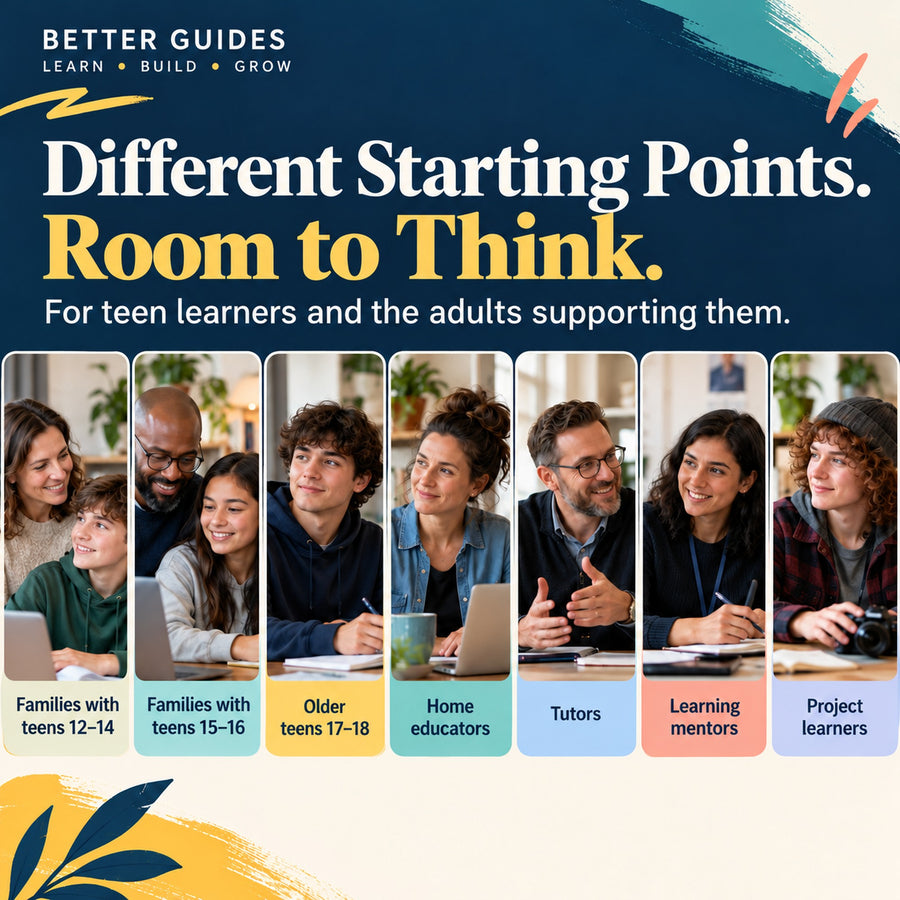
Seven fictional teen-learning and adult-supporter audience groups.

A closer look

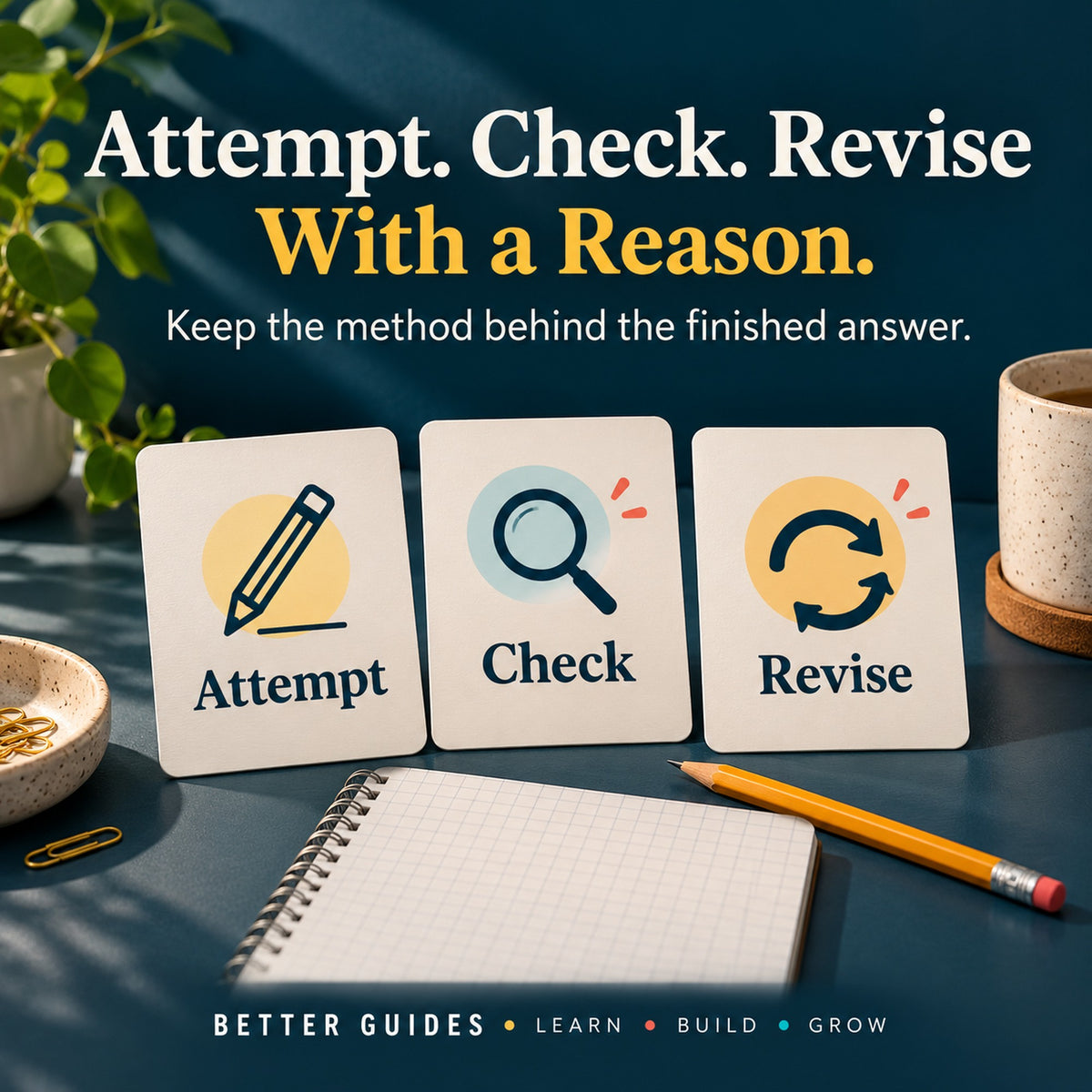
Attempt, check and revision steps in the teen reasoning workbook.

How It Works

  1. Purchase

    Complete your secure checkout.

  2. Download

    Access your digital files after purchase.

  3. Explore & Enjoy

    Put your new ideas into practice.

Frequently Asked Questions

Who is the Teen Learning Playbook for?

It is an optional English learning and project workbook for ages 12–18, with adult support for suitability, practical work and online use. Families, home educators and tutors can select tasks alongside other materials. It is not a complete curriculum, qualification or board-exam course.

What subjects and skills does it cover?

Critical reading, communication and writing, numbers and data, geometry and algebra, research/digital judgement, design projects and selected portfolio work. The focus is explaining methods, checking assumptions and making a reasoned revision across these selected topics.

How do the age routes and answer pages work?

Foundation, extension and application routes suggest different depths, rather than diagnosing ability or prescribing pace. Try the questions before reading the explanations. Revisit a worked model when useful, and justify open answers rather than copying a single suggested wording. Speaking, typing or labelled drawing can support a response.

Is the practice companion extra unique content, and are the PDFs fillable?

The Practice and Projects PDF repeats selected main-book pages, including relevant answer pages, for easier printing. It is not a second unique lesson set. The PDFs are reading/printing documents without fillable form fields; longer responses can continue in a notebook or another suitable format.

What does the learning planner do?

Excel includes Learning Week, Activity Library, Project Plan and Prompt Library. A valid Monday generates seven dated weekly rows. Optional entered activities and manual statuses are counted, without scoring ability or detecting duplicates. Library/project edits do not update the week. There are no automatic reminders or marking.

Does the teenager need an AI account or have to share work online?

No. Core activities can use paper, a notebook and suitable ordinary tools. AI prompts are optional and adult-operated, with human checks; follow the chosen service’s current terms and school rules. Use fictional/non-sensitive material and keep identifiers or private records out of AI and shared templates. Public posting is not required.

Is Google Sheets included, and does it match Excel automatically?

An existing native Google Sheets companion is linked through the book, resource page and QR. The linked Sheet is available to view. Sign in to a Google account and make a private copy before adding personal information. Excel does not sync with it. The revised Excel date guard was not mirrored to the Sheet. Native compatibility and printing remain unverified.

What supervision, materials or learning outcomes should I expect?

Read each setup before choosing materials. A responsible adult checks suitability and online/practical work; use a drawing or supplied fictional data when appropriate, and label a planned test honestly. The book supports optional practice and discussion. It has no independent educator endorsement or complete classroom/home-trial claim, and does not promise grades or diagnose ability.

Choose a Question Worth Explaining

Teen Activity Workbook Ages 12–18 | Think, Create & Explain

Rs. 299.00 Regular price Rs. 999.00 70% OFF